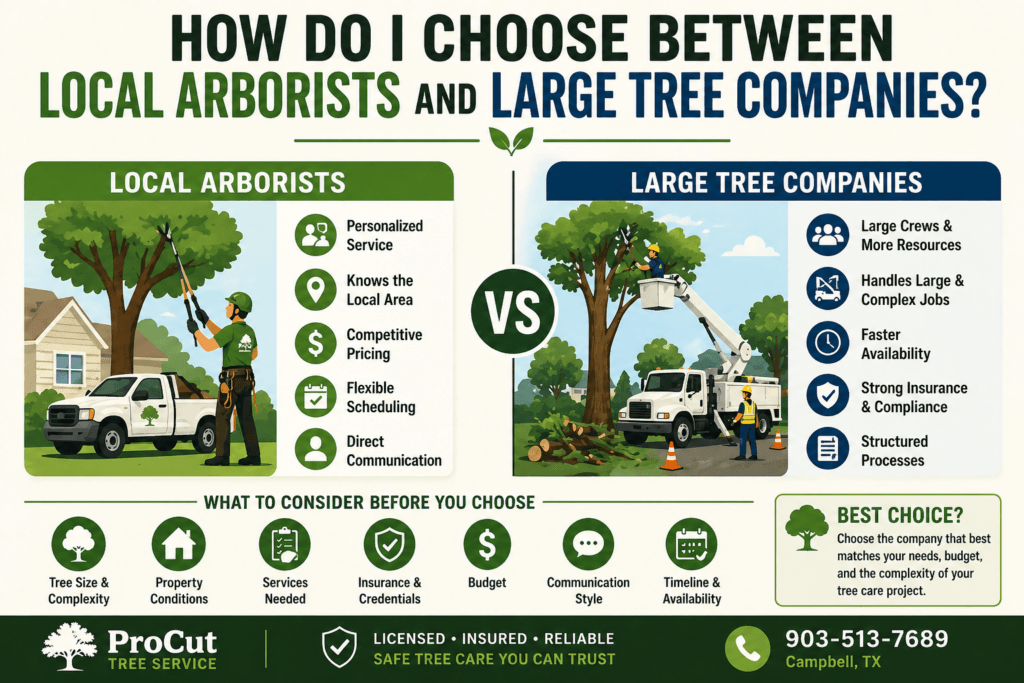
How to Choose Between Local Arborists and Large Tree Companies
Local arborists vs large tree companies is a practical comparison many homeowners face when they need tree trimming, tree removal, storm cleanup, stump grinding, or a professional opinion about a damaged tree. A local arborist may offer more direct communication, personalized service, and neighborhood familiarity. A larger tree company may offer more equipment, larger crews, broader scheduling capacity, and standardized processes. Neither option is automatically better for every situation.
The right choice depends on the tree, the property, the urgency, and the scope of work. A homeowner with one small tree that needs trimming may value a responsive local company. A commercial property with several hazardous trees may need a larger crew and specialized equipment. A storm-damaged tree near a roof may require both technical skill and safe removal planning. The goal is not to choose the biggest company or the lowest price. The goal is to choose the provider that is qualified for the actual job.
This guide explains how homeowners can compare local arborists and larger tree companies in a fair, practical way. It covers qualifications, safety, insurance, pricing, equipment, timing, communication, pros and cons, and questions to ask before hiring. ProCut Tree Service serves Campbell, TX and nearby communities, and this article is written to help property owners make a more informed tree care decision without pressure or confusion.
Local Arborists vs Large Tree Companies: Quick Answer
For routine residential tree trimming, small to medium tree removal, stump grinding, and direct homeowner communication, a local arborist or local tree service may be a strong fit. Local providers often understand nearby tree issues, weather patterns, soil conditions, and property layouts. They may also offer more flexible communication because the person giving the estimate may be closer to the actual crew or business owner.
For very large removals, multi-tree projects, commercial properties, tight deadlines, crane work, or complex equipment needs, a larger tree company may be worth considering. Larger companies may have more trucks, more crews, and broader scheduling capacity. They may also have formal office systems, standardized contracts, and dedicated customer service staff.
The best choice is usually the company that can explain the work clearly, provide proof of insurance, describe its safety plan, offer a written scope, and match the job’s complexity. A smaller local provider can be the better choice for one project, while a larger company can be the better choice for another.
What Is the Difference Between a Local Arborist and a Large Tree Company?
A local arborist or local tree service is often a smaller business that serves a specific town, county, or service area. The company may be owner-operated or have a small crew. The person who answers the phone, inspects the tree, writes the estimate, and performs the work may be closely connected. This can make communication easier and more personal.
A large tree company usually operates with more staff, more crews, more equipment, and a larger service area. These companies may handle residential work, commercial work, municipal work, storm response, land clearing, and large-scale tree maintenance. Their systems may be more formal, which can be helpful for bigger projects, but less personal for small jobs.
The word “arborist” is also important. An arborist is a tree care professional with knowledge of tree health, pruning, diagnosis, risk factors, and maintenance. Some arborists hold credentials through the International Society of Arboriculture, while some tree workers may have practical experience without formal certification. Credentials do not replace experience, but they can help homeowners identify professionals who have met recognized standards.
Side-by-Side Comparison
The table below gives a practical comparison. It does not mean every small company or large company fits the same pattern, but it shows common differences homeowners may notice.
| Factor | Local Arborist or Local Tree Service | Large Tree Company |
|---|---|---|
| Communication | Often direct, personal, and easier to discuss details with. | May use office staff, dispatchers, or formal communication systems. |
| Scheduling | May be flexible, but availability can be limited during busy seasons. | May have more crews and faster scheduling capacity for larger jobs. |
| Equipment | Usually enough for common residential trimming, removal, and cleanup. | May have cranes, lifts, larger chippers, and heavy-duty fleet support. |
| Pricing | May be competitive because overhead can be lower. | May cost more on smaller jobs but be efficient for large projects. |
| Service Area Knowledge | Often familiar with local neighborhoods, tree types, and property conditions. | May cover many regions and rely on broader operating systems. |
| Best Fit | Residential tree care, personal service, local projects, ongoing maintenance. | Large removals, commercial work, storm response, multi-crew projects. |
When a Local Arborist May Be the Better Choice
A local provider can be a strong choice when the job requires careful communication, property-specific judgment, or ongoing maintenance. Many homeowners prefer working with someone who knows the area and can explain the service in plain language. This can matter when the job is not simply “cut down the tree” but involves deciding whether trimming, removal, cabling, monitoring, or stump grinding makes sense.
A local arborist may also be easier to reach for follow-up questions. If you have a tree near a fence, a concern about cleanup, or a preference about keeping logs, direct communication helps. Local companies often rely heavily on reputation, reviews, referrals, and repeat customers, so service quality can be very important to them.
Local arborists may be especially useful for:
- Residential tree trimming and pruning
- Small to medium tree removal
- Tree health concerns
- Storm-damage assessment after moderate weather events
- Stump grinding and yard cleanup
- Personalized quotes for homeowners
- Ongoing maintenance for the same property
For homeowners in Campbell, Greenville, and nearby Texas communities, a local tree service may understand common residential access issues such as fenced yards, rural driveways, soft ground after rain, overhead utility concerns, and cleanup preferences. That local familiarity can make the estimate more realistic.
When a Large Tree Company May Be the Better Choice
A larger tree company may be better suited for complicated projects that require substantial equipment, multiple crews, commercial insurance documentation, or urgent scheduling after major storms. If a project involves several large trees, a crane, traffic control, municipal coordination, or commercial property management, a bigger operation may have more capacity.
Larger companies may also be useful for properties that need recurring large-scale work, such as apartment complexes, schools, business parks, utility corridors, or large rural properties. Their office systems may make it easier to process formal purchase orders, certificates of insurance, multi-property scheduling, or detailed work plans.
A large tree company may be the better fit for:
- Very large or high-risk removals
- Commercial or municipal tree work
- Multi-tree clearing projects
- Projects requiring cranes, bucket trucks, or large chippers
- Large storm-response operations
- Properties requiring formal documentation and administrative support
- Jobs that need multiple crews working at once
However, bigger does not automatically mean better. Homeowners should still ask for credentials, insurance, references, and a clear written scope. A large company can still provide vague estimates, and a small company can still be highly professional. The decision should be based on fit, not size alone.
Credentials, Insurance, and Safety Matter More Than Company Size
When comparing local arborists vs large tree companies, qualifications and safety practices matter more than the size of the business. Tree work can be dangerous, especially when it involves climbing, chainsaws, falling limbs, nearby structures, storm damage, or utility lines. A qualified provider should be able to explain how the work will be performed safely.
Homeowners should ask whether the company has proper insurance. Proof of insurance is important because tree work can involve property damage and worker injury risk. A verbal claim is not enough for higher-risk jobs. Ask for documentation when needed, especially for removals near homes, fences, vehicles, or neighboring property.
Credentials can also help. ISA Certified Arborists have passed exams covering tree care knowledge and must maintain their credentials through ongoing education. Not every tree job requires a certified arborist, but certification can be valuable when a tree’s health, structure, risk, or long-term preservation is part of the decision.
Basic safety questions include:
- Will the crew climb the tree, use a lift, or remove it from the ground?
- Will limbs be dropped or lowered by rope?
- How will the crew protect the roof, fence, driveway, and landscaping?
- Are utility lines involved?
- Does weather affect the timing of the job?
- Who is responsible for hauling, cleanup, and stump work?
Texas A&M Forest Service advises homeowners to be cautious around downed power lines, dangerous hanging limbs, and storm-damaged trees. That guidance reinforces a simple point: if the tree creates a safety hazard, the provider’s training and equipment matter more than the company label.
How Pricing Can Differ Between Local and Large Tree Companies
Pricing is one of the most common reasons homeowners compare providers. A local company may sometimes offer a more affordable quote because overhead is lower. A large company may charge more on small jobs because it carries more administrative, staffing, equipment, and fleet costs. But the opposite can also happen. A larger company may be more efficient on big jobs because it has the right equipment and crew size already available.
That is why the cheapest quote is not always the best quote. A low price with no written scope may leave out cleanup, hauling, stump grinding, or property protection. A higher price may include more complete service. Before deciding, homeowners should compare what each company is actually providing.
| Quote Item | Why It Matters | Question to Ask |
|---|---|---|
| Tree identification | Confirms which tree or trees are included. | Does this estimate cover every tree discussed? |
| Work method | Shows whether the tree will be climbed, felled, rigged, or removed in sections. | How will the tree be removed or trimmed safely? |
| Cleanup | Prevents confusion over branches, logs, chips, and final raking. | Is full haul-off included? |
| Stump grinding | Often priced separately from tree removal. | Is the stump included, optional, or excluded? |
| Access assumptions | Limited access can increase labor. | Will narrow gates, soft ground, or fences affect the price? |
| Insurance | Protects against property damage and worksite risk. | Can the company provide proof of coverage? |
Service Style and Communication Differences
For many homeowners, the service experience matters as much as the work itself. A local tree service may feel more personal. You may speak directly with the owner, estimator, or crew leader. That can make it easier to discuss concerns such as gates, pets, septic areas, landscaping, driveways, or whether to leave firewood on site.
A large tree company may feel more structured. You may receive a formal estimate, office follow-up, automated scheduling, and standardized paperwork. This can be helpful for homeowners who prefer a more corporate process or for property managers who need documentation.
Neither style is wrong. The better choice depends on what you value. If you want direct conversation and a local relationship, a local company may feel better. If you want administrative systems and larger crew capacity, a bigger company may feel more comfortable.
How to Judge Quality Before Hiring
Quality is not always obvious from a website or truck logo. Homeowners should look at how the company communicates during the estimate. A reliable tree professional should ask relevant questions, explain risks, discuss cleanup, and avoid making promises without seeing enough detail.
Warning signs can include vague pricing, pressure tactics, no proof of insurance, reluctance to explain the work plan, or a quote that is much lower than others without a clear reason. After storms, homeowners should be especially careful with door-to-door offers from people who cannot verify qualifications or insurance.
Positive signs include:
- Clear written scope
- Proof of insurance when requested
- Good explanation of safety concerns
- Realistic scheduling expectations
- Practical advice about trimming versus removal
- Respect for property, access, and cleanup concerns
- Local references, reviews, or repeat customers
Questions to Ask Before Hiring
Before choosing between providers, ask the same questions to each company. This helps you compare the answers fairly.
- Do you recommend trimming, removal, or monitoring, and why?
- Do you have experience with this type of tree and property condition?
- Can you provide proof of insurance?
- Will the estimate include cleanup and haul-off?
- Is stump grinding included or separate?
- How will you protect nearby structures, fences, and landscaping?
- Will utility lines affect the work?
- How will weather affect scheduling?
- Who will be on site during the job?
- What could change the final price?
When comparing local arborists vs large tree companies, the answers to these questions often reveal more than the company size. A smaller company with clear answers may be a better choice than a larger company with vague details. A larger company with the right equipment may be better than a smaller company that is not equipped for a high-risk tree.
How to Make the Final Decision
Start with the job itself. Is it routine trimming, a small removal, a large hazardous tree, storm cleanup, or a multi-tree project? Then match the provider to the work. A local arborist may be ideal for residential tree care and direct communication. A larger tree company may be better for highly complex removals or large-scale work.
Next, compare the estimate details. Look at what is included, not just the price. If one quote includes haul-off, stump grinding, and careful rigging, it should not be compared directly to a quote that only includes cutting the tree down.
Finally, consider trust. Tree work happens around homes, vehicles, fences, roofs, and landscaping. The company should communicate clearly, respect the property, and explain how the work will be done safely. If the job involves a hazardous tree, the provider’s safety plan and experience should carry more weight than a small price difference.
Local Tree Service Support in Campbell and Nearby Areas
For homeowners in Campbell, TX and nearby areas, ProCut Tree Service provides local tree care support for trimming, removal, cleanup, and related residential tree service needs. A local provider can be especially useful when you want direct communication, practical scheduling, and a clear explanation of what the job requires.
For more local information, these related resources may help: tree service in Greenville, TX, Greenville tree service, and tree service in Texas. These pages can help homeowners understand nearby service coverage and common tree care options.
You can also follow ProCut Tree Service updates on Pinterest, Blogspot, and Tumblr.
Short Takeaway
Local arborists vs large tree companies is not a one-size-fits-all choice. A local arborist or local tree service may be better for homeowners who want personal communication, local knowledge, and practical residential tree care. A larger company may be better for very large removals, commercial properties, heavy equipment needs, or major storm-response work.
The safest decision is to compare qualifications, insurance, written scope, cleanup details, equipment needs, and communication quality. Choose the provider that matches the actual risk and complexity of the job, not simply the company with the biggest name or the lowest price.
FAQ About Choosing Between Local Arborists and Large Tree Companies
Are local arborists better than large tree companies?
Not always. Local arborists may be better for personalized residential work and direct communication. Large tree companies may be better for complex removals, commercial properties, or projects requiring more equipment.
When should I hire a certified arborist?
A certified arborist is especially helpful when you need tree health advice, structural assessment, pruning guidance, or a decision about whether a tree can be saved. Certification can also be useful when a tree is valuable, mature, damaged, or near important property features.
Is a large tree company safer than a small local company?
Not automatically. Safety depends on training, insurance, equipment, planning, and experience. A small company can be very safe and professional, while a large company still needs to explain its safety process clearly.
Why do quotes vary so much between tree companies?
Quotes vary because companies may include different services. One quote may include full cleanup and stump grinding, while another may only include cutting. Access, tree condition, risk, equipment, and hauling also affect price.
Should I choose the cheapest tree service quote?
The cheapest quote is not always the best choice. Make sure the estimate includes the same scope, proper cleanup, insurance, and a safe work plan. A low quote with vague details can lead to surprises.
What should be included in a tree service estimate?
A good estimate should identify the tree, describe the work, clarify cleanup, explain stump grinding if needed, note access issues, and outline any safety concerns. It should be clear enough to compare with other quotes.
Can a local tree service handle large tree removal?
Some local companies can handle large removals if they have the right crew, equipment, and insurance. Others may be better suited for trimming, small removals, or maintenance. Ask about similar jobs they have completed.
How do I choose between local arborists and large tree companies?
Compare the job complexity, credentials, insurance, equipment, quote details, communication style, and cleanup scope. The right choice is the company that fits the tree, the property, and the level of risk involved.
Request a Local Tree Service Estimate
If you are comparing local arborists vs large tree companies for a tree project in Campbell, TX or nearby areas, ProCut Tree Service can help review the tree, explain the likely work scope, and provide a practical estimate based on the actual property conditions. Visit ProCut Tree Service or call 903-513-7689 for local tree service support.