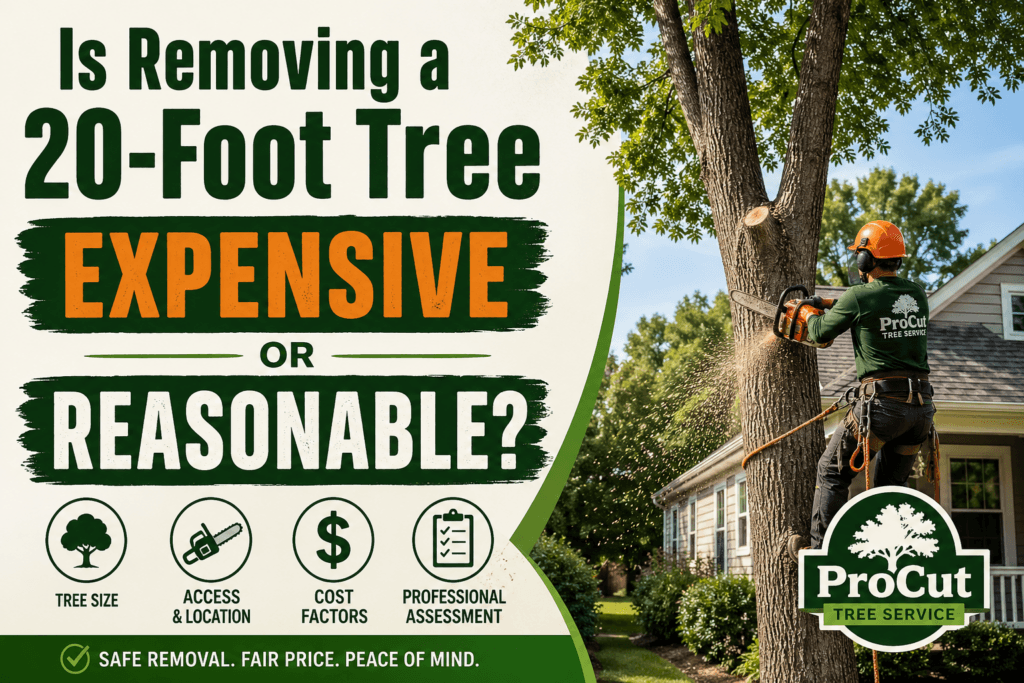
What’s the Average Cost to Remove a 20-Foot Tree?
Average cost to remove a 20-foot tree usually falls in the lower end of most tree removal price ranges, but the final number still depends on the tree’s condition, where it is located, how easy it is to access, and whether cleanup or stump grinding is included. In many residential situations, a 20-foot tree may cost roughly $250 to $900 to remove, with some jobs landing below or above that range depending on complexity. That is a planning estimate only, not a universal price list.
This guide explains what homeowners should realistically expect when pricing a 20-foot tree removal. It covers common cost ranges, the main factors that change the estimate, the difference between removal and trimming, common add-ons such as stump grinding, and practical questions to ask before scheduling the work. The goal is to help you compare quotes intelligently and understand why one 20-foot tree may be quick and affordable while another may require more labor and cost more.
Average Cost to Remove a 20-Foot Tree: Quick Answer
For many straightforward residential jobs, the average cost to remove a 20-foot tree is often in the range of $250 to $900. A small tree in an open yard with easy access can sometimes be cheaper. A 20-foot tree that is dead, leaning, near a roof, behind a fence, or tangled close to power lines or structures can cost more.
That broad range reflects the fact that tree removal is not priced by height alone. Even when the tree is only about 20 feet tall, trunk thickness, branch spread, nearby obstacles, and site conditions can all change the labor and safety plan. A short but heavy, wide, or unstable tree may be more difficult than a slightly taller tree in a clear open area.
So while 20 feet usually suggests a small-tree removal, it does not automatically mean a low flat rate. Homeowners should treat online averages as rough planning numbers and rely on a written quote for the actual cost.
Typical Price Range for a 20-Foot Tree Removal
Most 20-foot trees fall into the “small tree” category. In general, small tree removals tend to cost less than medium or large tree removals because they require less cutting, less time on site, and smaller debris loads. Still, the exact price depends on the work involved.
| 20-Foot Tree Situation | Typical Planning Range | Why It Costs That Much |
|---|---|---|
| Healthy tree in open yard | $250 to $450 | Easy access, lower risk, simple cutting and cleanup. |
| Tree with moderate branch spread or tight access | $450 to $700 | More careful cutting, hand carrying debris, longer cleanup. |
| Tree near house, fence, driveway, or landscaping | $600 to $900+ | Controlled lowering and extra site protection may be needed. |
| Dead, leaning, damaged, or hazardous tree | $700 to $1,200+ | Higher risk, slower work, and a more careful removal plan. |
| Stump grinding added | Add $100 to $400+ | Depends on stump size, root flare, depth, and access. |
These are not guaranteed price sheets. They are meant to help you understand how the job is usually evaluated. Some companies may quote on the lower side if the tree is very easy to access or if multiple trees are being removed on the same visit. Others may quote higher if the site requires more caution, cleanup, or labor.
What Affects the Cost of Removing a 20-Foot Tree?
Height matters, but it is only one part of the estimate. Here are the most common reasons the price of a 20-foot tree removal changes from one property to another.
1. Tree Type and Trunk Thickness
Two trees that are both 20 feet tall may not cost the same to remove. A tree with a thicker trunk or denser wood may take more effort to cut, section, and haul away. Some ornamental trees are light and simple to handle, while others are broader, heavier, and more time-consuming.
2. Tree Condition
A healthy tree is often more predictable to cut than a dead or damaged one. Dead trees may have brittle limbs or hidden rot. Storm-damaged trees can have cracked sections or hanging branches that create extra danger. Even at only 20 feet, a compromised tree may require a slower and more controlled removal process.
3. Access to the Work Area
If the crew can bring equipment and hauling tools close to the tree, the work is usually faster. If the tree sits behind a narrow gate, over soft ground, or in a fenced backyard, labor may increase because more debris has to be carried by hand. Limited access is one of the most common reasons a “small tree” quote increases.
4. Nearby Structures and Obstacles
A 20-foot tree in the middle of an open yard may be straightforward. A 20-foot tree leaning toward a home, fence, garage, patio cover, or neighboring property may need section-by-section removal. That means more careful cuts and sometimes ropes or lowering techniques, which can increase the cost.
5. Debris Removal and Cleanup
Some homeowners assume the price includes everything, but that is not always the case. Ask whether the estimate includes limb removal, trunk hauling, chipping, raking, and final cleanup. Leaving wood on site can reduce cost in some cases, while full haul-off may raise it.
6. Stump Grinding or Stump Removal
Tree removal usually means cutting the tree down to a stump. Grinding the stump is often priced separately. If you want the area smoother for mowing, landscaping, or replanting, stump grinding may be worth adding. Full stump removal is more invasive and is usually more expensive than grinding.
7. Urgency
Emergency or same-day tree work often costs more than standard scheduling. If a 20-foot tree has fallen after a storm, is blocking access, or threatens immediate damage, the price may reflect faster response, more risk, or less flexible scheduling.
Should You Remove or Trim a 20-Foot Tree Instead?
Not every 20-foot tree needs to be removed. Sometimes trimming is enough, especially when the tree is healthy and the issue is only overgrowth, clearance, or a few dead limbs. Removal makes more sense when the tree is dead, structurally unsound, too close to a structure, repeatedly causing damage, or simply unwanted in that location.
| Service | Best For | Main Benefit | Main Limitation |
|---|---|---|---|
| Tree trimming | Healthy trees with overgrowth or clearance issues | Preserves the tree and often costs less | May not fix structural or root problems |
| Tree removal | Dead, unstable, unwanted, or poorly placed trees | Eliminates the risk source entirely | Costs more and removes shade or landscape value |
| Stump grinding | Remaining stump after removal | Improves appearance and yard usability | Usually an extra cost |
If the tree is healthy and the problem can be solved with pruning, trimming may be the more practical and affordable option. If the tree is dead or located too close to a structure for long-term comfort, removal may be the better investment. A professional assessment helps clarify which choice makes more sense.
What Is Usually Included in the Price?
When homeowners compare the average cost to remove a 20-foot tree, they often focus only on the total number. It is just as important to look at what the quote includes. A lower price is not always a better price if the scope is much smaller.
A typical quote may include:
- Cutting down the tree
- Sectioning limbs and trunk pieces
- Basic debris removal
- Loading and hauling wood or branches
- Light site cleanup
Possible extra charges may include:
- Stump grinding
- Deep cleanup or heavy raking
- Log splitting or stacking
- Crane or special equipment use
- Emergency scheduling
- Work around hazards or limited access
Always ask if the company will leave the stump, cut it low, or grind it. Also ask whether branches and trunk pieces will be hauled away or left on the property. These details often explain why one quote is lower than another.
20-Foot Tree Removal Planning Table
The table below can help you think through the likely price before requesting a quote.
| Factor | Lower-Cost Scenario | Higher-Cost Scenario | Question to Ask |
|---|---|---|---|
| Location | Open front yard | Backyard behind fence or narrow gate | Can the crew access the tree easily? |
| Condition | Healthy and stable | Dead, cracked, or storm-damaged | Does the condition create extra risk? |
| Obstacles | Clear drop zone | Near roof, fence, driveway, or landscaping | Will sections need to be lowered carefully? |
| Cleanup | Basic removal only | Full haul-off, chipping, and raking | What level of cleanup is included? |
| Stump work | Stump left in place | Grinding included | Is stump grinding part of the quote? |
When the Price of a 20-Foot Tree Removal Goes Up
People often assume that a 20-foot tree should always be inexpensive because it is relatively small. That can be true in simple cases, but several conditions can push the quote higher.
For example, a 20-foot tree may cost more if:
- It is dead or partially hollow
- It leans over a roof or fence
- It is surrounded by landscaping that must be protected
- It is growing close to utility lines
- It has a wide canopy for its height
- The trunk is unusually thick
- The site is muddy or difficult to access
- The homeowner wants full cleanup and stump grinding
In short, “small” does not always mean “simple.” A cautious homeowner should focus on the actual work plan, not just the size of the tree.
Why Written Estimates Matter
If you are getting multiple quotes, make sure each company is quoting the same scope. One estimate may include removal only, while another includes full debris haul-off and stump grinding. Without matching scopes, it is difficult to compare prices fairly.
A useful written estimate should identify the tree, describe what work will be done, explain what cleanup is included, and note whether stump work is extra. It should also make clear if the company expects any access issues or risk-related challenges. That level of detail helps prevent surprises later.
For homeowners who want more local tree service information, these related ProCut Tree Service pages may also help: Tree Service Greenville TX, Greenville Tree Service, and Tree Service Texas.
Questions to Ask Before Hiring a Tree Service
Before booking a small tree removal, ask a few practical questions so you understand the quote clearly.
- Does the price include haul-off and cleanup?
- Will the stump be left, cut low, or ground down?
- Is the tree considered hazardous?
- Will any nearby fences, roofs, or landscaping need special protection?
- Can the crew access the tree with normal equipment?
- Can logs or wood chips be left on site if requested?
- What could cause the final price to change?
- How soon can the work be scheduled?
These questions are especially helpful when reviewing the average cost to remove a 20-foot tree because a broad online range can hide a lot of detail. The more clearly the scope is defined, the easier it is to judge whether the quote is reasonable.
Short Takeaway
Average cost to remove a 20-foot tree is often about $250 to $900 for a standard residential job, but the total can go higher if the tree is dead, hard to access, close to a structure, or paired with stump grinding and full cleanup. The tree’s height gives you a starting point, but the real price comes from the work required to remove it safely and cleanly.
The smartest way to plan is to compare written quotes with the same scope. Ask what is included, what is extra, and whether trimming could solve the problem instead. A thoughtful comparison helps homeowners avoid underestimating the job or overpaying for services they do not need.
FAQ About the Average Cost to Remove a 20-Foot Tree
What is the average cost to remove a 20-foot tree?
In many cases, the average cost to remove a 20-foot tree falls between $250 and $900. Simple jobs may cost less, while hazardous or hard-to-access jobs may cost more.
Is a 20-foot tree considered small?
Yes, in most tree service pricing categories, a 20-foot tree is usually treated as a small tree. However, trunk thickness, spread, and location can still make the job more complicated.
Does the cost usually include stump grinding?
Not always. Many companies price stump grinding separately. Always ask whether the stump is included in the base quote or offered as an add-on.
Why would a 20-foot tree cost more than expected?
The tree may be dead, leaning, close to a home, behind a fence, or difficult to access. Extra cleanup and risk control also raise the price.
Is trimming cheaper than removal?
Often, yes. If the tree is healthy and only needs shaping or clearance, trimming may cost less than full removal. Removal is usually the better option for dead, unstable, or unwanted trees.
Can I save money by leaving the wood on site?
Sometimes. If you keep logs or chips instead of having everything hauled away, the total cost may be lower. This depends on the company’s pricing structure and the amount of debris involved.
How long does it take to remove a 20-foot tree?
A simple 20-foot tree removal may take only a few hours. A more difficult removal near obstacles or with extensive cleanup may take longer.
How can I get a more accurate quote?
Provide clear photos, mention access issues, describe nearby structures, and decide whether you want stump grinding and full cleanup included. A more complete description usually leads to a more accurate estimate.
Local Tree Service Support
If you are comparing the average cost to remove a 20-foot tree and want a practical local estimate, ProCut Tree Service serves Campbell, TX and nearby areas with residential tree care, removal, trimming, and cleanup support. A site-specific quote is the best way to understand what your particular tree will cost based on access, risk, and cleanup needs.
To learn more, visit ProCut Tree Service or call 903-513-7689. You can also find additional company updates on Pinterest, Blogspot, and Tumblr.