How Much Does It Cost to Remove a 40-Foot Tree in Texas?
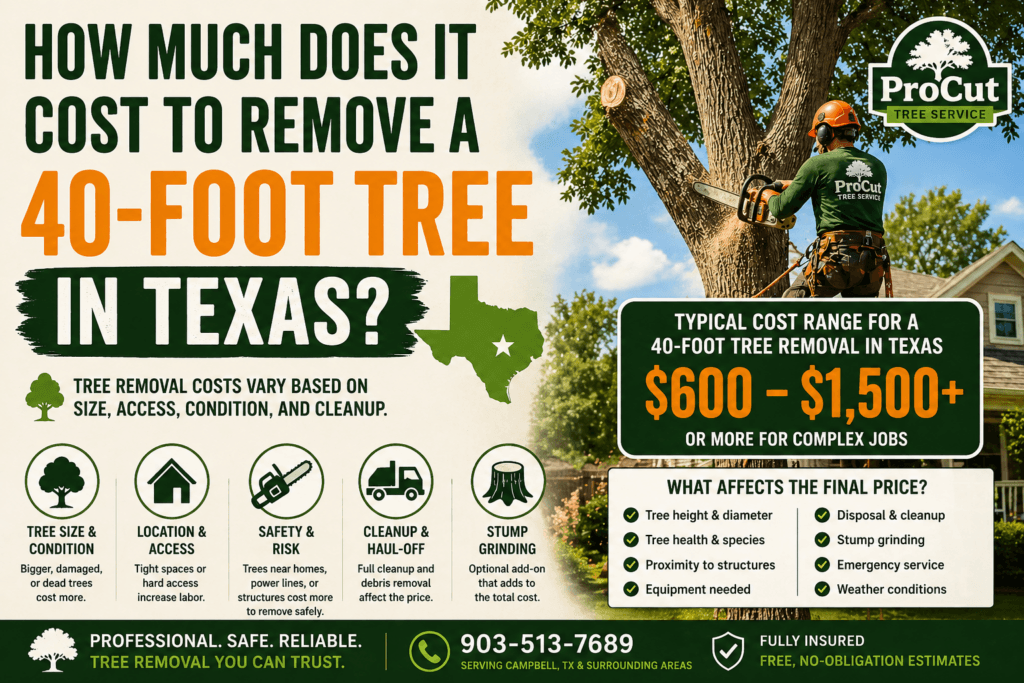
Cost to remove a 40-foot tree in Texas usually depends on tree condition, trunk thickness, access, nearby structures, debris cleanup, and whether stump grinding is included. A 40-foot tree is often considered a medium-size tree, which means it can cost more than a small ornamental tree but less than a large mature tree that requires extensive climbing, rigging, or heavy equipment.
For planning purposes, many homeowners may see a broad range of about $600 to $1,500 for a standard 40-foot tree removal. A simple tree in an open area may be closer to the lower end, while a dead, leaning, storm-damaged, or hard-to-access tree may cost more. If stump grinding, full haul-off, or emergency scheduling is added, the total can rise further.
This guide explains realistic pricing factors in a neutral way so Texas homeowners can compare quotes more confidently. It covers what affects the estimate, how removal compares with trimming, when prices increase, what should be included in a written quote, and what questions to ask before hiring a tree service.
Cost to Remove a 40-Foot Tree in Texas: Quick Answer
For a normal residential job, the cost to remove a 40-foot tree in Texas may commonly fall around $600 to $1,500. This is a practical planning range, not a fixed price. A tree in an open yard with easy truck access, stable condition, and basic cleanup may be less expensive. A tree near a home, fence, barn, driveway, power line, or neighboring property may require more controlled work and cost more.
A 40-foot tree can create a meaningful amount of debris. Even if the tree does not look huge from the ground, the branches, trunk sections, and cleanup can take several hours. The crew may need to cut the tree in sections, lower limbs carefully, haul heavy wood, rake the area, and manage the stump separately if requested.
Homeowners should avoid comparing quotes based only on the final number. One quote may include full cleanup and hauling, while another may only include cutting the tree down. One company may include stump grinding as an option, while another may leave the stump in place. The scope matters as much as the price.
Typical Price Range for Removing a 40-Foot Tree
A 40-foot tree is usually not a small removal, but it is not always a large removal either. It sits in the middle category where pricing can shift quickly based on risk and access. A healthy 40-foot tree with a clear drop zone may be straightforward. A 40-foot tree over a roof or leaning toward a fence may require ropes, climbing, controlled lowering, or more crew time.
| 40-Foot Tree Situation | Typical Planning Range | Why the Price Changes |
|---|---|---|
| Healthy tree in open yard | $600 to $900 | Clear access, lower risk, basic cutting, and standard cleanup. |
| Tree with moderate branch spread | $900 to $1,300 | More limbs, more debris, and longer cutting or hauling time. |
| Tree near house, fence, driveway, or landscaping | $1,200 to $2,000+ | Careful sectioning, possible rigging, and added property protection. |
| Dead, leaning, cracked, or storm-damaged tree | $1,500 to $3,500+ | Higher safety risk, unpredictable wood, urgent scheduling, or complex removal. |
| Stump grinding added | Add $150 to $600+ | Depends on stump diameter, root flare, soil, rocks, and access. |
These numbers are only planning estimates. The actual quote should be based on the tree’s height, trunk diameter, species, condition, lean, location, access, and cleanup expectations. A short phone estimate can help, but clear photos or an on-site review usually lead to a more accurate number.
Main Factors That Affect the Final Price
Tree removal is not priced by height alone. A 40-foot tree can be affordable or expensive depending on how complicated the work becomes. These are the most common factors that affect the estimate.
1. Tree Height and Trunk Diameter
Height gives the tree service a starting point, but trunk diameter often affects labor just as much. A 40-foot tree with a thin trunk and light limbs may be easier to remove than a shorter tree with a thick trunk and heavy wood. Dense hardwoods may require more cutting, more lifting, and more hauling.
2. Tree Species and Wood Density
Some trees are lighter and easier to section. Others have heavier wood, broad canopies, or limb structures that require more careful cutting. Species may also affect how the tree reacts during removal. A professional tree crew looks at more than height when deciding how much labor and equipment the job requires.
3. Tree Condition
A healthy tree is usually more predictable to cut. A dead, hollow, cracked, or storm-damaged tree can be more hazardous because limbs may break unexpectedly or the trunk may not support normal cutting methods. This can increase the cost to remove a 40-foot tree in Texas because the work may need to move slower and use more controlled techniques.
4. Location Near Structures
A 40-foot tree in an open field is different from a 40-foot tree next to a roof, garage, fence, shed, driveway, pool, patio, or neighboring property. When there is no safe drop zone, the crew may need to remove the tree in smaller pieces. That takes more time but helps reduce property damage risk.
5. Access for Equipment
Access is one of the biggest pricing factors. If a truck, trailer, chipper, lift, or other equipment can get close to the tree, the job may be more efficient. If the tree is in a tight backyard, behind a narrow gate, across soft ground, or surrounded by landscaping, the crew may need to carry more material by hand. More manual labor usually increases the estimate.
6. Cleanup and Haul-Off
Some homeowners want all branches, logs, chips, and debris hauled away. Others prefer to keep logs for firewood or chips for mulch. Full cleanup costs more because it adds labor, loading time, disposal time, and equipment use. Always ask whether cleanup is included before comparing quotes.
7. Stump Grinding
Tree removal usually means the tree is cut down, but the stump remains. Stump grinding is often a separate service. If you want the yard smoother for mowing, landscaping, or replanting, stump grinding may be worth adding. The price depends on stump width, root flare, ground conditions, and how deep the stump needs to be ground.
8. Emergency or Storm-Damage Work
After Texas storms, tree services may receive urgent calls for fallen limbs, trees on roofs, blocked driveways, and leaning trees. Emergency work can cost more because it may require faster scheduling, added risk, and more complex cleanup. If the tree is not an immediate hazard, standard scheduling may be more cost-effective.
Texas-Specific Considerations for 40-Foot Tree Removal
Texas properties vary widely. A homeowner in a rural area may have open access and fewer obstacles, while a homeowner in a tighter neighborhood may have fences, driveways, utility lines, sheds, and nearby structures to consider. These conditions can make the same size tree cost different amounts from one property to another.
Soil and weather conditions can matter too. After heavy rain, soft ground may limit equipment access or increase the chance of lawn damage. During windy conditions, climbing or controlled lowering may become less safe. A responsible tree service may adjust the schedule if conditions make the job riskier.
Before removing a tree, homeowners should also check local rules, HOA requirements, property lines, and utility concerns. Texas does not have one simple price or rule that applies to every property situation. Cities, neighborhoods, and utilities may have different expectations, especially when trees are close to easements, public areas, or overhead lines.
Removal vs. Trimming vs. Stump Grinding
Not every 40-foot tree needs removal. Sometimes trimming is enough, especially if the tree is healthy and the concern is clearance, dead branches, or limb weight. Removal makes more sense when the tree is dead, structurally unsafe, severely leaning, repeatedly damaging property, or located where future growth will create ongoing problems.
| Service | Best For | Main Benefit | Possible Limitation |
|---|---|---|---|
| Tree trimming | Healthy trees with overgrowth, low limbs, or deadwood. | Can improve clearance and reduce risk while keeping the tree. | May not solve decay, root issues, or structural instability. |
| Tree removal | Dead, leaning, badly damaged, or poorly placed trees. | Eliminates the risk source and opens usable space. | Costs more than trimming and removes shade or landscape value. |
| Stump grinding | Remaining stump after removal. | Improves mowing, appearance, and usable yard space. | Usually costs extra and does not remove every underground root. |
| Emergency tree service | Storm damage, blocked access, or immediate hazards. | Addresses urgent safety concerns quickly. | Can cost more than scheduled removal. |
If the tree is healthy and only needs clearance from a roofline or driveway, trimming may be the better first option. If the tree is unstable, cracked, dead, or too close to the home for long-term safety, removal may be more practical. A good estimate should explain why removal is recommended instead of simply pushing the highest-cost option.
Cost Planning Table for a 40-Foot Tree
Use this table as a practical checklist before requesting a quote. It can help you understand what the tree service will likely evaluate.
| Cost Factor | Lower-Cost Scenario | Higher-Cost Scenario | Question to Ask |
|---|---|---|---|
| Tree access | Open front yard with driveway access. | Backyard with narrow gate or soft ground. | Can equipment reach the tree safely? |
| Tree condition | Healthy, stable, predictable tree. | Dead, hollow, cracked, or storm-damaged tree. | Does the condition increase risk? |
| Nearby obstacles | Clear drop zone and open space. | Roof, fence, driveway, shed, pool, or landscaping nearby. | Will limbs need to be lowered by rope? |
| Cleanup | Basic cutting with some wood left on site. | Full haul-off, chipping, raking, and disposal. | What level of cleanup is included? |
| Stump work | Stump left low to the ground. | Stump grinding included with cleanup. | Is stump grinding included or separate? |
| Urgency | Standard scheduling. | Emergency, storm-related, or same-day work. | Is this priced as emergency service? |
How to Compare Tree Removal Quotes Fairly
When comparing the cost to remove a 40-foot tree in Texas, make sure every quote includes the same work scope. A low quote may only include cutting the tree down. A higher quote may include hauling, chipping, cleanup, stump grinding, and careful sectioning near structures.
A useful written estimate should answer these questions clearly:
- Which tree is included in the quote?
- Will the tree be felled, climbed, rigged, or removed in sections?
- Does the price include limb and trunk haul-off?
- Will the crew rake or clean the area after removal?
- Is stump grinding included, optional, or excluded?
- Are there any access concerns that could change the price?
- Does the company carry insurance for tree work?
- What happens if weather delays the job?
It is reasonable to ask for clarification if the estimate is vague. Tree removal has real risk, especially around structures and utility lines. A clear work scope protects both the homeowner and the service provider from confusion.
When a 40-Foot Tree Costs More Than Expected
A 40-foot tree can cost more than expected when the removal is not straightforward. This does not always mean the company is overcharging. Sometimes the tree simply requires more labor, more equipment, or more careful planning.
Price may increase when:
- The tree is dead, brittle, hollow, or cracked.
- The tree leans toward a house, garage, fence, barn, or neighbor’s property.
- The tree has large branches over a roof or driveway.
- The work area has limited access for equipment.
- The ground is wet, steep, narrow, or difficult to move across.
- The homeowner requests full cleanup and haul-off.
- Stump grinding is added to the job.
- The job is requested as emergency or storm-damage work.
These details matter because they change how the crew removes the tree. A simple tree can often be cut and processed efficiently. A risky tree may need to be removed piece by piece to protect nearby property.
How Long Does It Take to Remove a 40-Foot Tree?
A straightforward 40-foot tree removal may take a few hours. A more complex job may take most of a day, especially if the tree is near obstacles, has a wide canopy, requires careful sectioning, or includes full cleanup and stump grinding.
Weather can also affect the schedule. High winds can make removal less safe. Rain can make ground conditions difficult for equipment. After storms, tree services may prioritize urgent hazards such as trees on structures, blocked driveways, or dangerous hanging limbs.
If the tree is not an emergency, scheduling before it becomes hazardous may help avoid added risk. A declining tree can become more difficult to remove over time if it becomes brittle, unstable, or storm-damaged.
Can Homeowners Reduce the Cost?
There are a few practical ways to make the estimate more predictable, but safety should not be sacrificed to save money. Homeowners can help by clearing small items from the work area, moving vehicles, opening gates, and deciding ahead of time whether they want logs or chips left on site.
You may be able to reduce the total by keeping some wood instead of requesting full haul-off. You may also choose to delay stump grinding if the stump is not a problem right away. However, do not attempt to cut a 40-foot tree yourself unless it is truly safe, simple, and within your ability. Trees near structures, utility lines, fences, or roads should be handled professionally.
The better way to control cost is to request a detailed quote. Ask what is included, what is optional, and what could change the final number. This gives you a clearer basis for comparison.
Pros and Cons of Removing a 40-Foot Tree
Tree removal can solve safety and property issues, but it is still a major yard decision. A 40-foot tree may provide shade, privacy, curb appeal, and wildlife value. Before removing it, consider whether trimming could solve the problem.
| Potential Pros | Potential Cons |
|---|---|
| Reduces risk from dead, leaning, or damaged trees. | Removes shade and may change the yard’s appearance. |
| Can protect roofs, fences, driveways, and structures. | May cost more if stump grinding and full cleanup are added. |
| Opens space for repairs, landscaping, or future projects. | Can create a bare area that needs replanting or landscape repair. |
| May prevent higher emergency costs later if the tree is failing. | May not be necessary if trimming would solve the issue. |
If the tree is healthy and important to the landscape, trimming may be worth considering first. If the tree is dead, damaged, or too close to a structure, removal may be the more responsible choice.
Local Tree Service Support in Campbell and Nearby Areas
Texas homeowners comparing 40-foot tree removal quotes should work with a company that can explain the scope clearly. ProCut Tree Service serves Campbell, TX and nearby communities with tree removal, trimming, cleanup, and related tree care support.
For more local tree service information, these related pages may help: tree service in Greenville, TX, Greenville tree service, and tree service in Texas. These internal resources can help homeowners understand broader service options and common tree care needs in the area.
You can also review updates from ProCut Tree Service on Pinterest, Blogspot, and Tumblr.
Short Takeaway
Cost to remove a 40-foot tree in Texas is commonly influenced by access, condition, tree thickness, nearby structures, cleanup, stump grinding, and urgency. A standard removal may fall around $600 to $1,500, while hazardous, hard-to-access, or storm-damaged removals can cost more.
The most useful step is to compare written estimates with the same scope. Ask whether the quote includes hauling, cleanup, stump grinding, site protection, and any risk-related work. A detailed estimate is more helpful than a low number with unclear terms.
FAQ About 40-Foot Tree Removal Cost in Texas
How much does it cost to remove a 40-foot tree in Texas?
For many standard jobs, the cost may fall around $600 to $1,500. The price can be lower for a simple open-yard removal or higher for a tree near structures, utility lines, fences, or difficult access areas.
Is a 40-foot tree considered large?
A 40-foot tree is usually considered medium-size. It is larger than a small ornamental tree but often less complex than a mature 70-foot or 80-foot tree. The actual difficulty depends on trunk thickness, branch spread, condition, and location.
Does tree removal include stump grinding?
Not always. Stump grinding is commonly priced separately. Ask whether the stump will be left, cut low, or ground below the surface.
Why would a 40-foot tree cost more than another tree the same height?
Two trees with the same height can have different prices because of trunk diameter, wood density, lean, branch spread, condition, access, nearby structures, and cleanup needs.
Is emergency removal more expensive?
Usually, yes. Emergency removal may cost more because it can involve storm damage, urgent scheduling, higher risk, unstable limbs, or blocked access.
Can trimming be cheaper than removing a 40-foot tree?
Often, yes. If the tree is healthy and the issue is clearance or overgrowth, trimming may be less expensive. Removal is more appropriate when the tree is dead, unstable, badly damaged, or poorly located.
How long does it take to remove a 40-foot tree?
A simple removal may take a few hours. More complex jobs near structures, fences, landscaping, or utility concerns may take most of a day, especially when full cleanup or stump grinding is included.
How do I get the most accurate estimate?
Provide clear photos, describe access, mention nearby structures, and ask for a written scope. A good estimate should explain removal, cleanup, haul-off, stump work, and any site-specific concerns.
Request a Local Tree Removal Estimate
If you are researching the cost to remove a 40-foot tree in Texas, ProCut Tree Service can help review the tree, explain the likely work scope, and provide an estimate based on the actual property conditions. For local help in Campbell, TX and nearby areas, visit ProCut Tree Service or call 903-513-7689.